

By Enes Ayasli |
On June 12, 2026, the European Union’s new Pact on Migration and Asylum entered into application. The Commission presented the new rules as reinforced by “migration diplomacy with partner countries.” The practice behind the phrase is ten years old. Europe has managed migration less at its own borders than through bargains with the governments beyond them: Türkiye in 2016, Tunisia in 2023, and Mauritania, Egypt, and Lebanon in 2024. Each bargain traded European money for help in keeping migrants and refugees away from Europe. Together, they have quietly changed who needs whom. Europe now depends on its partners to hold the line, and that dependence gives them leverage over Europe. What Europe gives up in exchange is its willingness (and/or responsibility) to criticize. Although Europe’s own treaties commit it to defending democratic values abroad, it raises them less and less, to keep its migration bargains alive.
From leverage to reverse leverage
In an influential 2005 article, Levitsky and Way defined Western leverage as authoritarian governments’ “vulnerability to external democratizing pressure.” Conditionality, sanctions, and diplomatic pressure worked best, they argued, where the West had no competing priorities. Where Western governments had important economic or security interests at stake, as in much of the Middle East, they were “less likely to maintain a consensus behind demands for political reform.” Levitsky and Way even listed immigration among the priorities that kept Washington from imposing political conditions on Mexico.
Migration control has since become Europe’s overriding priority in its neighborhood. However, the problem runs deeper than a weaker voice. Scholars of International Relations have shown that governments can turn the movement of people into a bargaining chip. Adamson and Tsourapas call this migration diplomacy. Greenhill identifies more than fifty attempts, since the 1951 Refugee Convention, at what she calls coercive engineered migration: population movements “deliberately created or manipulated” to extract concessions from other states. She argues that liberal democracies are especially exposed, because turning people back at the border opens a gap between their professed values and their actual conduct. She calls the political price of that gap “hypocrisy costs.”
Türkiye has made the point explicitly, and more than once. As Okyay and Zaragoza-Cristiani observed soon after the 2016 deal, Türkiye’s role as gatekeeper made it indispensable to Europe, and that shifted bargaining power toward Ankara. In November 2016, as the European Parliament voted to freeze accession talks, President Recep Tayyip Erdoğan warned that “these border gates will be opened.” In late February 2020, after an air strike killed Turkish soldiers in Syria’s Idlib province, a senior Turkish official told Reuters that Türkiye would no longer stop Syrian refugees from reaching Europe by land or sea. “We will not close those doors,” Erdoğan said on February 29. “Why? Because the European Union should keep its promises.” Thousands of people gathered at the Greek border within days. Europe’s response was not to rethink the bargain but to extend it to new partners.
Paying regardless of democracy
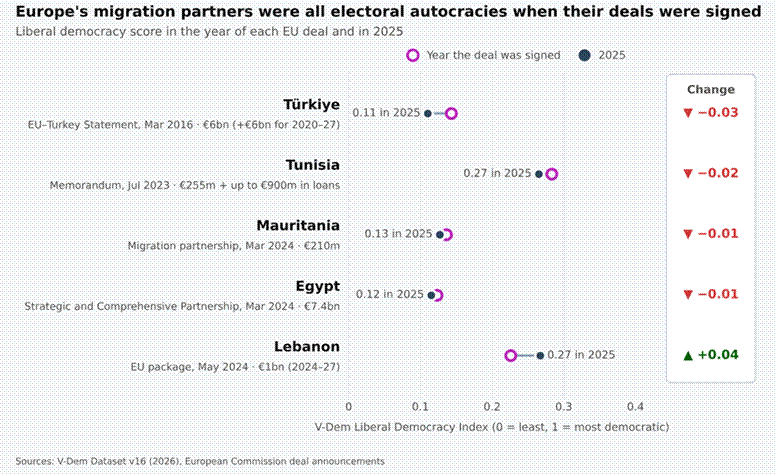
Figure 1. Liberal democracy scores of the EU’s migration partners in the year each deal was signed and in 2025. Source: V-Dem Dataset v16 (2026).
With whom did Europe strike these bargains? By the classification in the latest V-Dem data, all five partners were electoral autocracies in the year their deals were signed (see Figure 1). The money did not follow democratic trends in either direction. Türkiye’s score fell from 0.23 to 0.14 in the year of its deal and has stayed near 0.11 since, while EU funding for refugees in the country has reached nearly €12.4 billion since 2011. Mauritania’s score fell after its 2024 partnership, and Egypt’s €7.4 billion package was pledged to a country already near the bottom of the scale. Nowhere is the mismatch clearer than in Tunisia. After President Kais Saied suspended parliament in 2021 and began ruling by decree, Tunisia’s score on V-Dem’s liberal democracy index fell from 0.62 in 2020 to 0.20 in 2022 (see Table 1). The EU signed its memorandum of understanding with Saied’s government in July 2023, promising €105 million for migration management, €150 million in budget support, and up to €900 million in loans. Lebanon’s score rose in 2025, after a new president and government took office, but its €1 billion package had been announced a year earlier, while the score was still falling.
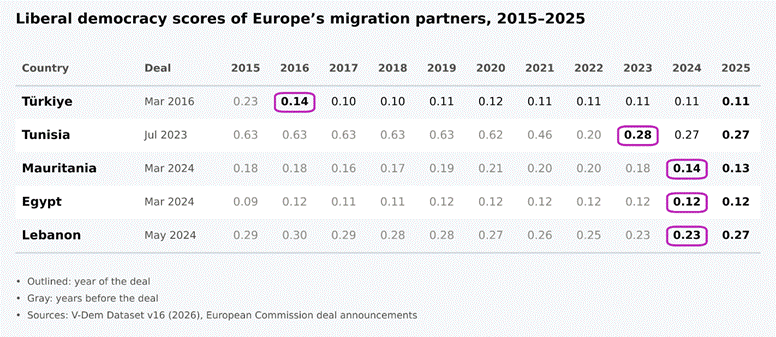
Table 1. V-Dem liberal democracy scores, 2015–2025, for Türkiye, Tunisia, Mauritania, Egypt and Lebanon
How silence is bought
Reverse leverage does not cause backsliding. Governments dismantle checks on their own power for domestic reasons. Bermeo’s term for the most common route today is executive aggrandizement, in which elected incumbents weaken checks on executive power one by one through legal channels, and her illustration was Erdoğan’s Türkiye. But Bermeo also stresses that backsliding responds to international incentives, and migration bargains change those incentives in three ways.
First, they hollow out conditionality. EU macro-financial loans normally require partners to respect effective democratic mechanisms, the rule of law, and human rights. The 2025 decision on Egypt’s €4 billion loan, which followed a €1 billion loan in 2024, asks only that Cairo “continue to make concrete and credible steps” toward them, while the loan agreement ties each tranche to reforms spelled out in more than sixty specific, mostly economic, measures. Economic reforms are spelled out and counted while democratic ones are left to a vague clause.
Scrutiny is the second casualty. In October 2024, the European Ombudsman found that the Commission had signed the Tunisia deal without a standalone human rights impact assessment and had not made its internal risk assessment public. In 2015, while it was negotiating migration cooperation with Ankara, the Commission held back its critical annual report on Türkiye until after the November election. Turkish opposition parties drew the connection, but Brussels denied it.
Third, they lend legitimacy. When European leaders fly in to sign partnerships with presidents who are concentrating power, the photographs pay off at home: the president is received as a statesman, and his critics are made to look marginal. In Tunis in July 2023, the Commission president stood beside Saied with the prime ministers of Italy and the Netherlands. In Cairo in March 2024, she and five European heads of government joined President Abdel Fattah el-Sisi to announce Egypt’s package.
Defenders of these deals have a point. Countries that host millions of refugees carry real costs, and fairer burden-sharing is long overdue. EU money for refugees in Türkiye has paid for cash assistance, schooling, and health care on a large scale. The problem is not that Europe pays host countries. It is how Europe pays. It pays in ways that hand partner governments leverage over Europe while asking little of them in return, and that makes eroding democracy cheaper.
Conclusion
Europe can keep supporting host countries on different terms. First, it should separate support for refugees from support for regimes, channeling help for refugees and host communities through UN agencies, civil society, and local authorities, and treating budget support and loans to governments as a separate decision. Second, it should publish the terms of every bargain, along with the risk assessments behind them. Third, it should tie government-to-government money to benchmarks that can be measured and monitored independently, with published criteria for suspension, as the Ombudsman has urged in the case of Tunisia. Fourth, it should give the European Parliament a real say before deals are signed, not after.
The new Pact deepens Europe’s dependence on governments willing to hold the line for it. Levitsky and Way taught a generation of scholars that international leverage could help democracy. Europe’s migration bargains show that leverage can also run the other way. Unless Brussels learns to bargain as hard for democratic commitments as it does for border control, it will keep paying for its borders with its voice.
References
Pact on Migration and Asylum enters application (European Commission, June 12, 2026): https://home-affairs.ec.europa.eu/news/new-migration-and-asylum-rules-enter-application-what-changing-2026-06-12_en
EU–Turkey Statement (Council of the EU, March 18, 2016): https://www.consilium.europa.eu/en/press/press-releases/2016/03/18/eu-turkey-statement/
Treaty on European Union, Article 21: https://eur-lex.europa.eu/eli/treaty/teu_2016/art_21/oj/eng
Levitsky and Way (2005), “International Linkage and Democratization,” Journal of Democracy 16(3): 20–34: https://doi.org/10.1353/jod.2005.0048
Adamson and Tsourapas (2019), “Migration Diplomacy in World Politics,” International Studies Perspectives 20(2): 113–128: https://doi.org/10.1093/isp/eky015
Greenhill (2010), Weapons of Mass Migration (Cornell University Press): https://www.degruyterbrill.com/document/doi/10.7591/9780801458668/html
Okyay, A., & Zaragoza-Cristiani, J. (2016). The Leverage of the Gatekeeper: Power and Interdependence in the Migration Nexus between the EU and Turkey. The International Spectator, 51(4), 51–66. https://doi.org/10.1080/03932729.2016.1235403
Bermeo (2016), “On Democratic Backsliding,” Journal of Democracy 27(1): 5–19: https://www.journalofdemocracy.org/articles/on-democratic-backsliding/
European Parliament calls for freezing accession talks with Turkey (press release, Nov 24, 2016): https://www.europarl.europa.eu/news/en/press-room/20161117IPR51549/freeze-eu-accession-talks-with-turkey-until-it-halts-repression-urge-meps
Erdoğan, “Border gates will be opened if you go too far” (Anadolu Agency, Nov 25, 2016): https://aa.com.tr/en/todays-headlines/border-gates-will-be-opened-if-you-go-too-far-erdogan/692962
Turkey will no longer stop Syrian refugees (Reuters report, Feb 27, 2020, via Duvar English): https://www.duvarenglish.com/human-rights/2020/02/28/turkey-will-no-longer-stop-syrian-migrant-flow-to-europe-says-official
Erdoğan, Feb 29, 2020 (Al Jazeera): https://www.aljazeera.com/news/2020/02/29/erdogan-vows-to-keep-doors-open-for-refugees-heading-to-europe/
EU support for refugees in Türkiye (European Commission): https://enlargement.ec.europa.eu/countries/turkiye/eu-support-refugees-turkiye_en
EU–Tunisia MoU (Euronews, July 16, 2023): https://www.euronews.com/2023/07/16/tunisia-and-eu-sign-a-strategic-partnership-on-economy-and-migration
European Ombudsman decision on the EU–Tunisia MoU (Oct 21, 2024): https://www.ombudsman.europa.eu/decision/193851
EU–Egypt partnership factsheet (European Commission, March 2024): https://ec.europa.eu/commission/presscorner/api/files/attachment/877847/STR_EU-EG%20partnership.pdf
EU–Egypt package announced in Cairo (Ahram Online, March 17, 2024): https://english.ahram.org.eg/NewsContent/3/12/519550/Business/Economy/EU-pledges-%E2%82%AC-billion-aid-and-investment-package-fo.aspx
Council Decision (EU) 2024/1144 on €1 billion macro-financial assistance to Egypt: https://eur-lex.europa.eu/eli/dec/2024/1144/oj/eng
Decision (EU) 2025/1267 on macro-financial assistance to Egypt: https://eur-lex.europa.eu/legal-content/EN/TXT/?uri=CELEX:32025D1267
EIPR on the conditionality of the EU loan to Egypt (Dec 2025): https://eipr.org/en/node/5216
EU–Mauritania partnership signed March 7, 2024 (Agence Europe): https://agenceurope.eu/en/bulletin/article/13366/7/european-commission-signs-new-partnership-with-mauritania-on-managing-migration-and-developing-economic-opportunities
EU €1 billion for Lebanon (EMN Belgium, May 2, 2024): https://emnbelgium.be/nl/node/4468
Delayed 2015 Turkey progress report (bne IntelliNews): https://www.intellinews.com/european-commission-releases-delayed-progress-report-for-turkey-83498/
V-Dem Dataset v16 (March 2026), via the vdemdata package: https://github.com/vdeminstitute/vdemdata